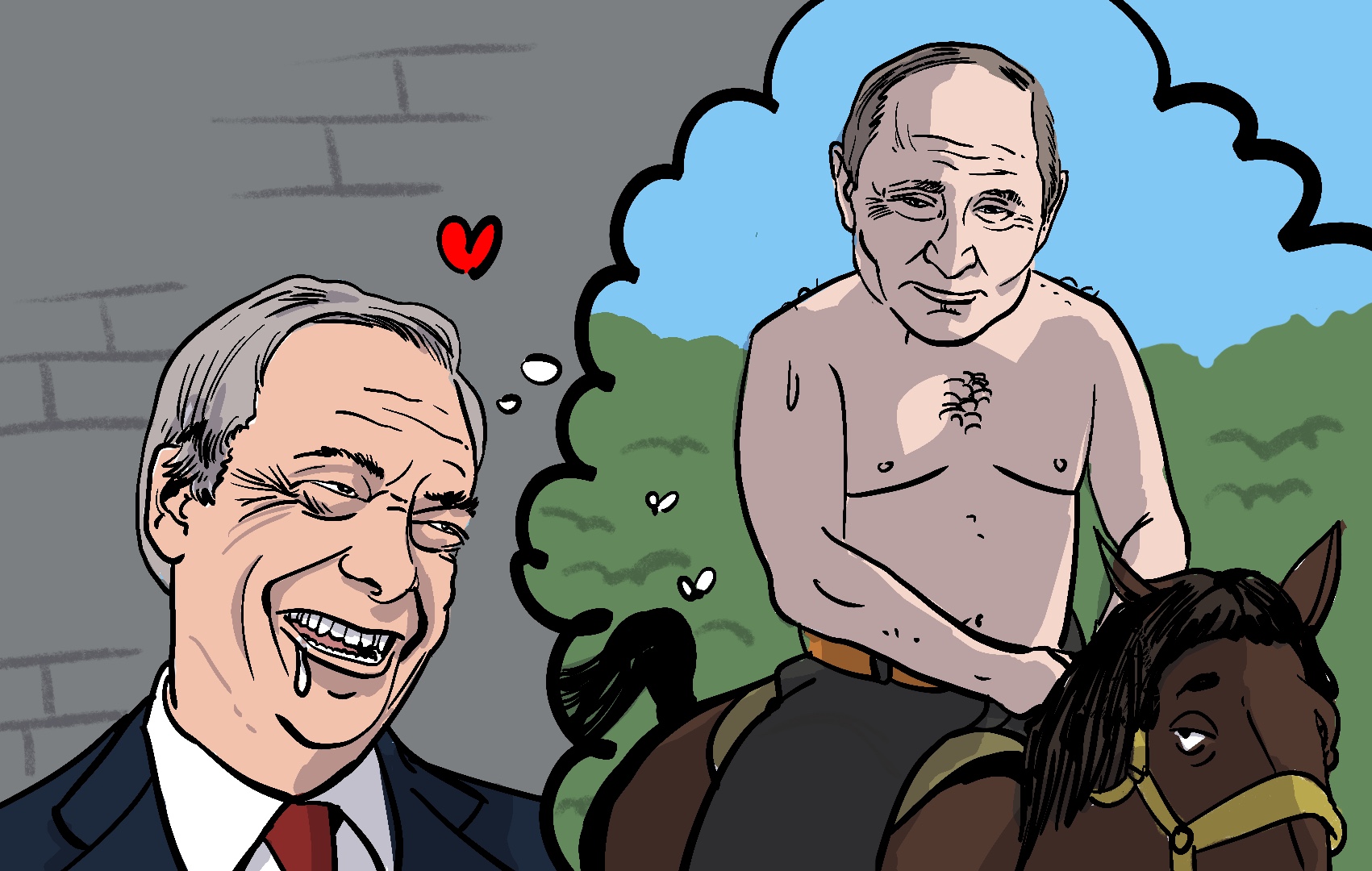
Below is an overview of Russia interference in Britain. Considering the range of connections between Farage, Reform UK and Russia it isn’t credible that Farage can deny any links:
- Farage said he admired Putin in 2014
- Farage met the Russia Ambassador 2013
- Farage appeared on Russia controlled Russia Today 17 times before 2014
- Farage pro-Russian talking points and worldview
- Reform UK donors’ Russian links
- Arron Banks, key Farage ally, with strong Russia links
- Andy Wigmore, another Farage ally with Russia links
There has been a strange lack of interest by UK governments (both Tory and Labour) in Russia interference in Britain, read more here.
MI5 is now warning of the growing threat of foreign interference in the UK’s democratic institutions.
Overview of Russia interference in Britain
Russia’s hybrid warfare strategy:
Russia, under Putin, uses non-military tools like cyberattacks, financial influence, and disinformation to weaken Western democracies.
Focused on Europe and the UK after 2012, especially following Crimea’s annexation in 2014.
Russia’s support for the radical right in Europe through financial influence and its oligarch networks:
Russian oligarchs in London and Europe were leveraged to fund sympathetic politicians and parties. Examples include loans and support to European far-right parties (Le Pen, Salvini, AfD). Read more here.
Transnational network of Russian influence that has sought to destabilize democracies in Ukraine, the US, and the UK. Read more here.
In the UK, Russia operatives actively targeted MPs and MEPs.
Early UK interference:
Evidence of attempts during the 2014 Scottish independence referendum.
Russian-linked troll farms and online campaigns aimed to manipulate public opinion and voting behavior.
Brexit referendum (2016):
Kremlin aimed to exploit divisions in the UK; left-leaning and right-leaning narratives amplified.
Russian-backed disinformation campaigns promoted pro-Leave messages in 2016: Russian media (e.g., RT) and troll farms.
Key UK figures (Arron Banks, Nigel Farage) met with Russian diplomats or officials; no conclusive evidence of direct collusion.
The Tory UK Government and intelligence services showed an “extraordinary lack of curiosity” regarding potential Russian interference in the 2016 Brexit referendum. Read more here.
Cambridge Analytica and information warfare:
Micro-targeting and psychological profiling were used to influence voters.
Possible data sharing or coordination with Russian-linked actors.
Government response and Russia report:
The 2020 Russia report confirmed Russian interference attempts but noted lack of serious investigation by UK authorities.
Government reluctance to act on the report attributed to political sensitivities and potential compromise of Tory MPs.
Farage and Reform UK:
Farage’s 2024 claim that the West “provoked” Russia caused a drop in party support. Highlights ongoing risks of Russian-aligned narratives influencing UK politics.
Methods of interference:
- Troll farms, social media manipulation, misinformation campaigns, online radicalization.
- Financial inducements and political lobbying, including pro-Russian questions in European Parliament.
- Russia criminal money laundering network and National Crime Agency operation.
- Modern Russian espionage 2.0 no longer looks like Cold War spycraft, it’s outsourced, deniable, and decentralised, using ordinary people to carry out small, low-cost acts of sabotage and influence. Read more here.
Impact on democracy:
UK elections and referenda potentially swayed by external actors. Weak regulation of campaign finance and digital donations (including crypto) poses ongoing threats.
Lack of interest in Russia interference by the UK government and media
The 2020 Russia Report warned of widespread Russian interference but there has been a clear lack of interest about this by the UK Tory government at the time. Five years later, little has changed: no reforms, no funding transparency, and no public inquiry. Carole Cadwalladr warns that Britain is now facing a “different kind of war” with Russia through disinformation and infiltration.
The Citizens, a civic group, has taken the UK government to the European Court of Human Rights, arguing that its refusal to investigate Russian interference violates citizens’ rights to free and fair elections. After Gill’s guilty plea, their case for a full public inquiry is stronger than ever.
Russia’s support for the radical right in Europe through financial influence and its oligarch networks
Sam Freedman argues that although Russia has long interfered broadly in foreign politics to sow chaos, from the 1990s onward it has built particularly deep and mutually beneficial relationships with Europe’s radical right. These ties have ideological, strategic, and financial dimensions, and they have become more significant as both Putin’s worldview and the European far right have evolved.
Origins of the Russia–radical right connection
- After the collapse of the USSR, Russian ultranationalists like Aleksandr Dugin sought links with Europe’s far-right, especially the French Nouvelle Droite under Alain de Benoist.
- Dugin translated far-right European literature, introduced ethnonationalist ideas into post-Soviet Russia, and helped craft a philosophy that opposed Western liberalism and U.S. dominance.
- Vladimir Zhirinovsky, leader of the “Liberal Democratic Party,” also brought far-right groups together internationally. His 1990s and early-2000s initiatives created early networks among ethnonationalist parties, with tacit approval from Russian authorities.
Putin’s shift toward illiberal nationalism
- Initially pragmatic, Putin became more ideologically hardened after:
- the colour revolutions in Georgia (2003) and Ukraine (2004),
- Russia–West tensions post-2007,
- domestic protests in 2011–12,
- declining economic performance after the financial crisis.
- Putin increasingly adopted rhetoric resembling Dugin’s: the “spiritual unity” of Russia, anti-liberalism, and hostility toward Ukrainian sovereignty.
- Dugin’s ideas permeated state-aligned media and parts of Russia’s elite, though he never held formal office.
Russia’s support for European radical-right parties
Freedman documents multiple cases of cooperation:
France (National Front / National Rally)
- Marine Le Pen developed close ties with Moscow from 2013.
- Her party received €11 million in loans from Russian banks in 2014 during a period of financial desperation.
- In return, Le Pen echoed Kremlin positions, e.g., insisting Crimea was Russian and opposing EU sanctions.
Italy (Lega / Lega Nord)
- Matteo Salvini forged ties with Putin beginning in 2014.
- Lega created Russia-focused “cultural associations,” with Dugin as an honorary leader in one branch.
- A 2019 leak revealed negotiations to covertly fund Lega through discounted oil deals, though no deal was proven.
- Salvini’s party reliably repeated Russian talking points about Crimea and sanctions.
United Kingdom (UKIP / Reform)
- Nigel Farage worked for Russia Today for years, amplifying narratives about Western decline.
- A Reform/UKIP MEP, Nathan Gill, was bribed by Russian agents to promote Kremlin-friendly positions in the European Parliament.
- UKIP/Brexit MEPs often opposed resolutions critical of Russia.
Germany (AfD)
- After a 2015 ideological split, the AfD became more ethnonationalist and more useful to Russia.
- Some AfD MEPs were allegedly involved in Russian-linked payment schemes.
- The party remains one of the few major Western European radical-right groups still openly sympathetic to Moscow after 2022.
Post-2022 recalibration
Following Russia’s full-scale invasion of Ukraine:
- Most Western European radical-right parties toned down overt support due to public backlash.
- Yet Freedman argues their underlying ideological affinity remains intact.
- Russia now relies more on leaders in Eastern Europe, like Hungary’s Viktor Orbán and Slovakia’s Robert Fico, who are more openly aligned.
The political risk ahead
Freedman warns that:
- Radical-right parties are rising across Europe and may soon govern major states such as France, Austria, and potentially Germany.
- Even if these governments do not openly align with Putin, they could undermine European unity by:
- deprioritising military and financial support for Ukraine,
- adopting “domestic-first” justifications for inaction,
- eroding EU cohesion from within.
In France especially, a National Rally government after 2027 could critically weaken European support for Ukraine.
Conclusion
Russia’s long-term cultivation of the radical right—ideological, financial, and strategic—now coincides with the far right’s rising electoral strength. Freedman argues Europe must reinforce Ukraine’s position and internal unity now, before radical-right victories create an opportunity for Russia to exploit these relationships and reshape European foreign policy.
Transnational network of Russian influence that has sought to destabilize democracies in Ukraine, the US, and the UK
Carole Cadwalladr has a broader transnational network of Russian influence that has sought to destabilize democracies in Ukraine, the US, and the UK, linking Nathan Gill’s bribery scandal to this network. The “peace plan” Gill was paid to promote in the European Parliament mirrors earlier Russian disinformation efforts. This transnational web of Russian influence operations spanning Brexit, Trump, and Ukraine, showing how propaganda, data manipulation, and money have been deployed to undermine Western democracies.
“Sergei & the Westminster Spy Ring” is a podcast that investigates an alleged Russian influence operation within British politics. It features journalists Carole Cadwalladr and Peter Jukes, alongside Conservative party whistleblower Sergei Cristo. The series reveals a complex web of espionage, manipulation, and political intrigue.
Key Themes
Russian Influence Operations
- The podcast uncovers how Russian agents infiltrated the British political system.
- It discusses tactics such as honey traps and information warfare used to sway political decisions.
Whistleblower’s Perspective
- Sergei Cristo shares his experiences and concerns about Russian interference.
- His attempts to alert authorities about suspicious activities were largely ignored.
Historical Context
- The series draws parallels to past espionage cases, notably the Cambridge spy ring.
- It highlights the ongoing threat of foreign interference in democratic processes.
(https://the-citizens.com/2025/02/sergei-and-the-westminster-spy-ring/)
Targetting of MEPs
The Nathan Gill Russia bribary scandal
Two other Ukip MEPs, David Coburn and Jonathan Arnott, travelled with Gill to Ukraine in 2018 and made similar statements in the European parliament shortly afterward, though there’s no suggestion they accepted bribes. Their travel was funded by the “European Centre for Democracy and Human Rights,” later revealed to be a front linked to Russian intelligence. Its president, Janusz Niedźwiecki, was arrested in Poland on espionage charges. (https://observer.co.uk/news/politics/article/nathan-gill-jail-former-reform-politician-awaiting-bribery-sentence-mep)
WhatsApp messages between Nathan Gill and Russian agent Oleh Voloshyn name Ukip/Brexit party MEPs David Coburn and Jonathan Arnott as potential recruits to repeat Russian propaganda lines. There is no suggestion Coburn or Arnott took bribes
Notable Russian actors involved:
- Viktor Medvedchuk: Ukrainian oligarch, close to Putin, key figure in European influence networks.
- Yevgeny Prigozhin: Head of Internet Research Agency, managed troll farms and disinformation campaigns.
- Alexander Yakovenko: Russian ambassador to London, involved in political engagement with UK actors. He played a central role in a Kremlin strategy to weaken Western alliances ahead of Russia’s 2014 invasion of eastern Ukraine and annexation of Crimea. Yakovenko was later honoured by Putin and reportedly boasted in 2019 that Russia had “crushed the British to the ground,” highlighting the perceived success of these influence operations.
- Sergei Nalobin infiltrated the Conservative Party through the Conservative Friends of Russia group.
- Alexander Udod targeted UKIP, meeting Farage’s ally Andy Wigmore in 2015.
- Oleh Voloshyn, a Ukrainian politician described by US authorities as an “FSB pawn
- Konstantin Kilimnik, the Russian intelligence operative tied to Paul Manafort and Trump’s 2016 campaign
- Farage’s links to Oleh Voloshyn, a Ukrainian politician tied to Russian intelligence, who Nathan Gill admitted taking bribes from. (link to weakness page on Farage Russia links)
Cadwalladr also reflects on her own legal battles over earlier Russia-related investigations, describing how SLAPP lawsuits were used to silence her and other journalists exposing Kremlin links to Brexit and Trump. She urges public support for The Citizens’ legal campaign to force a full public inquiry into Russian interference in UK democracy.
Russia criminal money laundering network and National Crime Agency operation
UK Takes Russian Interference Seriously – But the Media Isn’t Paying Attention
- Background: Russian influence in the UK has been ongoing, from politicians echoing Kremlin narratives (like Nigel Farage) to bribery cases such as Nathan Gill’s 10-year sentence. Previous investigations were limited due to government inaction.
- Operation Destabilize: The National Crime Agency (NCA) recently revealed a vast Russian-backed money-laundering network funneling millions from UK street crime into cryptocurrency, ultimately funding Russia’s military and espionage operations. Key networks identified include Smart and TGR, with couriers, money launderers, and high-level operators all playing roles.
- Global threat: Laundered funds enabled sanctions evasion, armed Russia’s military, and supported espionage, showing how local crimes link directly to international destabilization. Russian spy vessels, like the Yantar, highlight ongoing hybrid threats.
- Significance: The operation demonstrates that the UK is now actively investigating and disrupting Russian interference, though media coverage remains limited. Transparency and vigilance are critical to protecting national security.
Russia Espionage 2.0
Modern Russian espionage no longer looks like Cold War spycraft, it’s outsourced, deniable, and decentralised, using ordinary people to carry out small, low-cost acts of sabotage and influence. The UK’s Met Police and MI5 describe these individuals as “proxies,” gig-economy-style agents working for cash or confusion rather than ideology. Russia uses these outsourced gig workers to wage a slow, invisible war on public trust, exploiting loopholes in law, finance, and politics while Britain struggles to see or stop the system behind the chaos.
Recent cases show how this works:
- In Leyton (2024), a group of young Britons were recruited online via Telegram, paid in cryptocurrency linked to Russian intelligence, and ordered to burn down a warehouse storing aid for Ukraine.
- In another case, a Bulgarian spy ring run by Orlin Roussev conducted large-scale surveillance in the UK, using forged documents and cheap tech to monitor dissidents and embassies. Both networks were tied to Wagner and Jan Marsalek, the fugitive ex–Wirecard executive now in Moscow.
These examples expose “espionage-as-outsourcing” where criminals, contractors, and freelancers perform small, deniable acts for hostile states. The structure is layered for maximum deniability: low-level operatives face prosecution, while those funding and directing them remain untouchable.
Britain’s new National Security Act (2023) and Foreign Influence Registration Scheme criminalise aiding foreign intelligence services, but they only target symptoms, not the financial and digital infrastructure, crypto channels, shell firms, lobbying fronts that enable this system.
A pending ECHR case (Bradshaw & Others v UK) argues the UK must investigate foreign interference in its democracy, potentially forcing a long-delayed public inquiry. Such an inquiry could trace how money and influence move from crypto wallets to campaign donations, exposing how ordinary politics becomes a delivery system for foreign power.
Ultimately, Russia’s strategy is described as a “cold war on trust” not about winning battles, but about corroding faith in truth and democracy through countless small, deniable acts that make democratic institutions look hollow and unreliable.
Russia interference in the Brexit referendum
In the context of Brexit, Russia reportedly viewed the UK’s EU referendum as a strategic chance to weaken Western alliances. The UK Parliament’s Intelligence & Security Committee (Russia Report) confirmed that Russian efforts to influence UK politics were significant, though it did not claim the referendum’s result was directly affected.
Leave.EU Campaign & Farage
Nigel Farage, as the public face of Leave.EU, ran highly targeted campaigns, using social media and data-driven techniques to amplify nationalist messages, such as the controversial “Breaking Point” poster. The campaign exploited local frustrations and exaggerated threats from the EU.
Because Nigel Farage played a central role in the Leave campaign, questions remain about the extent to which his messaging, deliberately or inadvertently, aligned with Russian strategic interests, particularly in promoting anti-EU sentiment.
Foreign Funding & Media Links
There are concerns over illegal overseas funding and the role of Russian media, particularly RT (Russia Today). Farage’s media income, including from RT, grew significantly from 2012–2018, though he denies taking Russian money for the campaign. RT is recognized as reflecting the Russian government’s position.
Arron Banks & Andy Wigmore
Banks and Wigmore, central figures in Leave.EU, admitted to multiple meetings with the Russian ambassador. These discussions were connected to Brexit, raising concerns about potential Russian influence. Banks showed a dismissive attitude, treating Parliamentary scrutiny as a joke and avoiding detailed questions about funding.
A key factor in this alignment was Farage’s close partnership with Arron Banks, the businessman whose financial backing transformed UKIP and later funded Leave.EU, the campaign that brought Farage international prominence. Their collaboration became one of the defining relationships of the populist Brexit movement, linking political influence, private money, and potential foreign interests.
Government & Intelligence Services’ Inaction:
The UK’s response to potential Russian influence in Brexit was minimal, characterized by limited inquiry, uncooperative witnesses, and a broader reluctance to question the referendum outcome, leaving unresolved concerns about foreign interference. The Tory UK Government and intelligence services for an “extraordinary lack of curiosity” regarding potential Russian interference in the 2016 Brexit referendum.
Unlike the US Mueller investigation, UK authorities lacked the powers and will to fully investigate Russian interference. The DCMS committee could not compel witnesses or access detailed evidence. MPs and intelligence committees later acknowledged this lack of scrutiny appeared partly aimed at avoiding challenges to the referendum result.
Banks and Wigmore eventually left the DCMS committee hearing abruptly, avoiding questions about overseas funding. Their connections to Russia remain largely unexplained.
European Parliament (EPRS) — Foreign interference in EU democratic processes (2022, PDF)