
A clear majority of the UK public think that Reform UK is a far-right party. A poll conducted for HOPE not hate of 7,000 people found that 60% of the public view Reform UK as a “far-right populist party”. (p27 state of hate report https://hopenothate.org.uk/state-of-hate-2025/)
Nick Lowles from HOPE not hate argues that RUK’s public positions (immigration, demonisation of minorities, conspiracy theories, support for autocratic regimes, dismantling core tenants of the rule of law) are more extreme that those of the British National Party (BNP) at its peak.
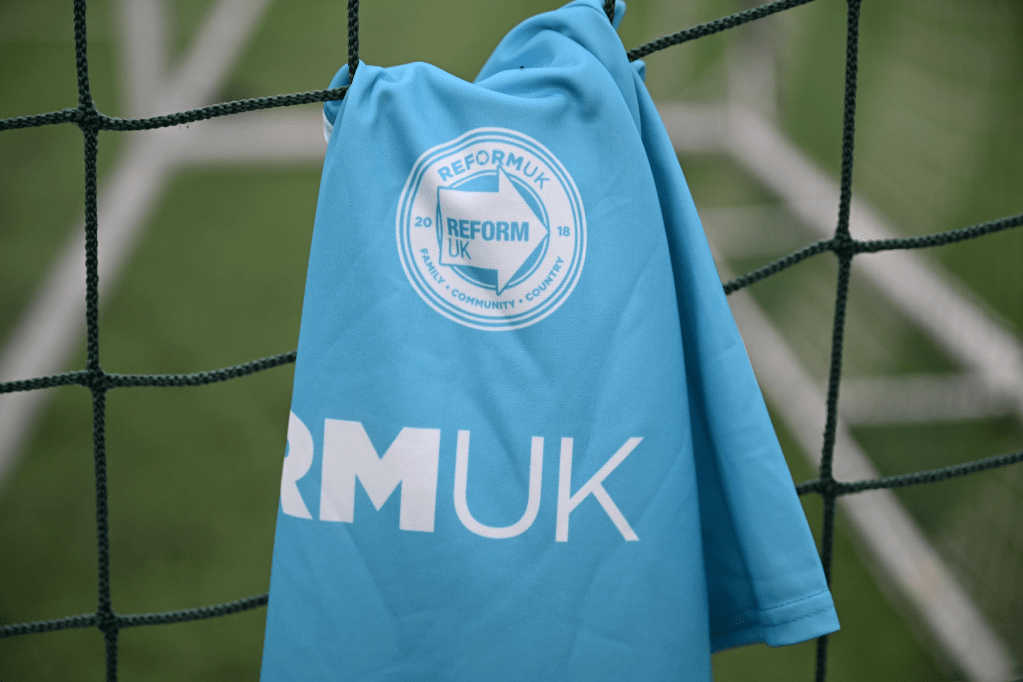
RUK released a football kit in November 2025. Reform UK’s new black football shirt is deliberately designed as a neo-Nazi dog whistle. The black colour echoes historic fascist “Blackshirts,” the gold emblem resembles Nazi badges, and the date “2018” is split so the logo’s arrow highlights “18”, a well-known neo-Nazi code for “Adolf Hitler.” Though Reform UK denies any link, these choices intentionally signal to extremist supporters while remaining deniable.
Key Themes of Far-Right Politics
- Thrive on division: instead of offering real solutions, far-right parties fuel anger and resentment, undermining trust in democracy, targeting vulnerable communities, and positioning themselves as the only ones who “tell the truth.”
- Exploit public frustration: millions of people feel let down by mainstream politics, and Reform UK is tapping into that disillusionment to push their own extreme agenda.
- Racist and xenophobic rhetoric: Far-right movements often use rhetoric that targets ethnic minorities, immigrants, and other marginalized groups. Reform UK, led by Nigel Farage, has been described as engaging in this kind of discourse, particularly focusing on asylum seekers and Muslims.
- Undermine democracy: Far-right groups tend to challenge the legitimacy of democratic processes. Farage has repeatedly questioned election results, particularly when they don’t align with his political agenda, invoking racial or ethnic factors as supposed explanations.
- Attack Human Rights: Far-right groups often advocate for policies that undermine human rights or reject international human rights frameworks. For instance, Farage has called for the UK to withdraw from the European Convention on Human Rights, a fundamental human rights treaty.
- Highlight Populism and the Elite Conspiracy: A hallmark of the far-right is a populist rhetoric that frames political elites as corrupt or as enemies of “the people.” Farage frequently portrays himself as fighting for ordinary citizens against a powerful, corrupt elite, fostering division and mistrust in democratic institutions.
- Push the narrative of the nation in crisis. The “nation” is defined as an in-group that is under attack from an external group or enemy. Reform UK defines this out-group as migrants, asylum seekers and Muslims.
- Promote Nationalism. Nationalism is the belief that a nation should rule itself and align with its own state. It promotes national sovereignty, unity, and identity based on shared culture, history, or values. Definitions of “nation” vary, leading to different forms of nationalism, mainly ethnic and civic.
Far-Right vs. Fascism
- It’s important to note the distinction between far-right and fascism. While fascism is an extreme form of far-right ideology that seeks to dismantle democracy altogether, far-right politics can include less extreme groups that still support core democratic structures but reject elements of liberal democracy.
- Reform UK fits into the “non-fascist far-right” category because it maintains a commitment to democracy in some sense, while still promoting anti-democratic ideas, such as the rejection of universal human rights.
- While Farage and the leadership of Reform UK try to distance themselves from overt fascism, there are clear overlaps between their anti-immigrant rhetoric and far-right extremism. There are already tensions within the party regarding how closely it should align with figures like Tommy Robinson, who represents a more explicitly far-right, street-level movement.
- It’s possible a Reform UK government would be proto-fascist. Fascist governments do not form immediately, they evolve. The Nazi movement in Germany can be seen as a form of proto-fascism before it fully developed into fascism under Adolf Hitler. Thsis phase included elements like extreme nationalism, anti-communism, and the scapegoating of minorities, which laid the groundwork for the totalitarian regime that followed. We can see how Trump’s government has evolved from nationalist to the proto-fascist authoritarian government in the US.
Farage’s Role
Farage is positioned as the face of Reform UK, and his long history of controversial statements aligns with far-right rhetoric, including advocating for the rejection of key democratic values like the European Convention on Human Rights and using language that fuels xenophobia. Read more about Farage’s far-right views and actions here.
The Dangers of Normalizing Far-Right Rhetoric
Failing to accurately describe groups like Reform UK as far-right is harmful. Reform UK’s rise is part of a broader trend of far-right parties gaining traction in Europe and North America. As Reform gains ground, there is a risk that it will normalize discriminatory, anti-immigrant views and policies. This could embolden more extreme factions within the party, making it harder to draw a clear line between Reform and fascist ideologies.
British politics is being dragged to the right:
- Reform UK’s shift toward mass deportations stems not from public demand but from far-right online networks. Anonymous X accounts seed extreme ideas that are amplified by disaffected right-wing figures and normalised through a radicalised online ecosystem boosted by Musk’s platform changes. Mainstream influencers then echo these narratives, creating a false sense of public support despite broad opposition.
- The Tory Party is becoming alarmingly extreme – The Conservatives’ proposal to revoke indefinite leave to remain and deport up to 5% of the UK’s legal population would target people with low incomes or anyone receiving “social protection”—including pensioners, maternity pay recipients, carers, and long-term residents. The plan resembles historic mass expulsions, is extremely unpopular (3% support), and would turn the UK into a temporary-labour society like Dubai. It is more extreme than past far-right policies and politically benefits Nigel Farage by pushing the Conservatives further from mainstream opinion.
The Importance of Terminology
Using precise terminology—specifically the term far-right—is essential to correctly characterize the policies and ideologies of groups like Reform UK. By downplaying or avoiding the label, there’s a risk of normalizing harmful politics that undermine democratic values and human rights.
(Sources: https://bylinetimes.com/2024/10/07/why-reform-uk-is-far-right/, https://hopenothate.org.uk/2024/09/24/reform-uk-are-far-right-heres-why/)

 STOP REFORM UK