
Elite Leadership and Funding:
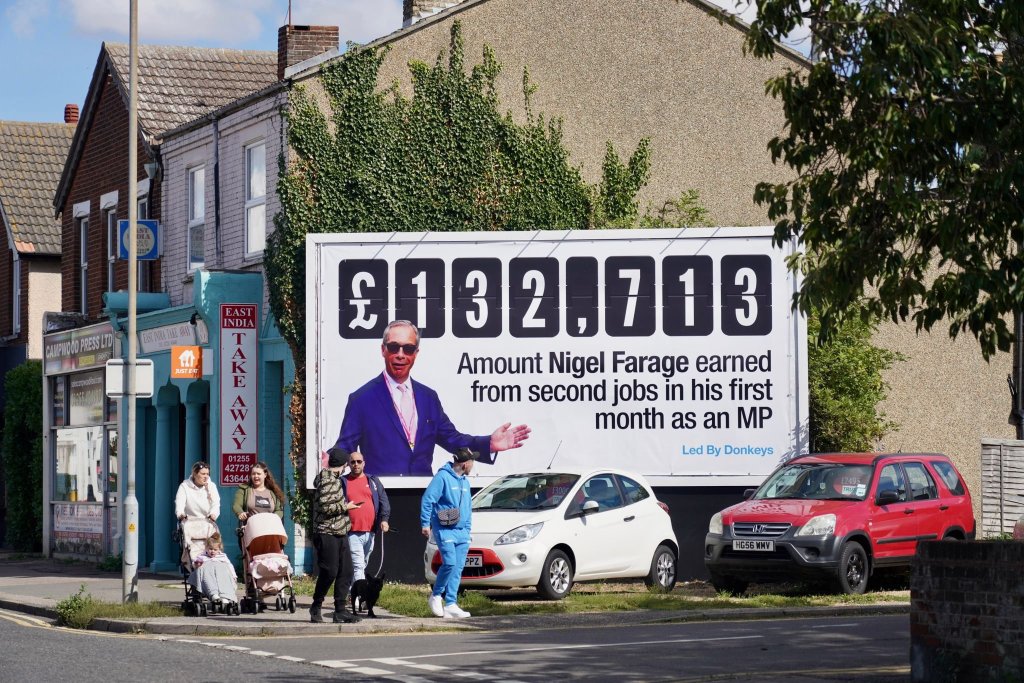
- The party’s leadership, including Farage, Richard Tice, and Zia Yusuf, come from business backgrounds, with many holding significant wealth. Farage, for example, earns over £1 million annually through various business ventures and media roles.
- A significant portion of Reform’s funding comes from multimillionaire donors with ties to sectors like finance, property, technology, oil and gas. This reflects the party’s pro-business agenda, which includes tax cuts for corporations and a reduction of public spending.
People around Farage
- John Hall Life President, a former Tory donor
- Arron Banks, accused of being a Russia agent
- James Orr, chair of Reform’s think tank The Centre for a Better Britain (CBB) (see details below), Cambridge academic, a close ally of JD Vance, sceptical of Ukraine support and openly sympathetic to authoritarian “national conservatism.” His reactionary views include opposing abortion at every stage of pregnancy, including in cases of rape. He thinks the US Capitol riot of January 2021 was exaggerated by the “global left”. He believes diversity weakens nations. He finds Britain’s armed forces compromised by inclusive recruitment adverts. He admires American gun laws.
- “Posh George” Cottrell, Farage advisor, aristocratic private banker and been in prison in the US for fraud
- Nick Candy, RUK treasurer and fundraiser, has recently invested with the same Silicon Valley donor bloc that powered Donald Trump’s return, offering a glimpse into the machine powering Reform’s pro-fossil fuel agenda. His firm was put in Covid ‘VIP lane’
- Charlton Edwards RUK director and secretary, promoted conspiracy theory and far-right content online
- Alex Phillips, advisor to Richard Tice, “Make Science Racist Again” is the title of her latest blog, in which she argues against “regarding all humans as biological equals”.
- Matt Goodwin, head of its new student organisation, has argued people from minority ethnic backgrounds born and raised in UK were not always British
- Jack Eccles, president of Reform UK’s new youth wing, has said on numerous occasions – that the King is “anti-British” and attended the Tommy Robinson Unite the Kingdom rally in 2025.
- Jack Aaron oversees future candidate vetting, Aaron has praised Hitler as “brilliant” and described Syrian dictator Bashar al-Assad as “gentle”, raising serious concerns about the type of candidates he may deem acceptable.
- Michael Hadwen, party’s director of campaigns and training, has shown support for Enoch Powell and the far-right commentator Milo Yiannopoulos.
- Paul Nuttall, Vice Chairman, who has propagated conspiracy theories about global warming, expressed anti-Muslim views, and criticised “the very existence” of the NHS.
- James Catton, donor manager, has a shocking history of promoting extreme and racist content on social media.
- Simon Marcus head policy advisor, who spreads conspirary theories about elites spreading the covid vaccine, climate crisis and the Russia-Ukraine war. Marcus was in charge of producing Reform’s election manifesto. Now it makes much more sense that the manifesto included wacky details about Covid lockdowns being apparently “based on shoddy evidence and lies” and a pledge to “reject the influence of the World Economic Forum”, a common bugbear of conspiracists.
- Adam Bounds national director, tried to recruit members to a “physical resistance group” for “guerillas by night tactics” and promoted far-right and conspiracy theory content.
- Councillor Jaymey McIvor, national Director of Local Government, he was previously expelled from the Conservative Party over denied claims that he sent an unsolicited explicit image.
- Kevin Byrne, Small Business for Reform, supports Tommy Robinson and peddles conspiracy theories
- Ethan Thoburn (parliamentary business manager), in 2017, Ethan Thoburn was an enthusiastic supporter of the serial criminal and anti-Muslim extremist Stephen Lennon (AKA Tommy Robinson). He shared Lennon’s Twitter posts 91 times that year.
- Far-right conspiracy theorists working for Reform UK
- Pete Durnell (West Midlands regional director)
- Jake Fraser (Head of Discipline)
- Dave Holland (Eastern regional director)
- Nick Harris (Reform HQ)
Reform’s Think Tank – The Centre for a Better Britain (CBB)
- The Centre for a Better Britain (CBB) is being set up to supply policy, legislation, candidates, and advisers for a future Reform UK government led by Nigel Farage.
- US MAGA and Orbán influence: Inspired by Trump’s Heritage Foundation, Project 2025 and Hungary under Viktor Orbán, CBB promotes cutting the state, opposing DEI, weakening public services, and pursuing constitutional overhaul.
- Key figure: Chaired by Cambridge academic James Orr, a close ally of JD Vance, sceptical of Ukraine support and openly sympathetic to authoritarian “national conservatism.”
- Funding concerns: Aims to raise up to £25m from UK and US donors, raising fears of foreign influence; current backing appears narrow and donor-dependent.
- Strategic aim: Professionalise Reform UK rapidly, embed US-style culture-war politics, and prepare a radical governing programme—despite major credibility, cost, and democratic risks.
Party Ownership Structure
- While legally Reform UK is no longer owned by Farage, he still controls the party, and members have very little power in the day-to-day running of it. Reform UK, formerly the Brexit Party, is now a private company, Reform 2025 Limited.
- The structural issues and the difficulty for members to challenge Farage’s leadership make it unclear how much real change has been achieved. Nigel Farage retains control as a “guarantor” alongside Yusuf, making it difficult for members to replace him. The mechanisms for removing Farage, including a vote by MPs or a petition from members, are impractical due to the party’s small size and scattered membership.
- The party lacks a committee structure, centralizing power in Farage’s hands. To fully democratize, significant legal changes would be required, but Farage seems unwilling to relinquish control, fearing the infighting that plagued UKIP.
- Membership rights are limited to voting on policies at party conferences and removing the leader if 50% of members write to the party.
Reform Party Infrastructure and Membership
- The creation of over 300 branches, with plans to reach 500, suggests that they are not just focusing on national headlines.
- Reform is focusing on building teams, raising money, finding good political candidates and building a presence in local communities. They are focusing on hyper-local issues to help them to build credibility and trust, which might help counterbalance the perception that they are a fringe party.
- The growth of their membership to over 200,000, surpassing the Conservative Party’s own membership, is also a notable sign of their expanding grassroots presence.
 STOP REFORM UK