Farage’s ongoing relationship with far-right figures and groups, both within UKIP and the Brexit Party, is a core aspect of his political persona. While he repeatedly disavows far-right affiliations, evidence of these connections has remained strong throughout his career.
Farage Literally Caught Recording Far-Right Slogans for Money Online
As recently as March 2026 Nigel Farage was found to be working a side-hustle recording video selfies to order (reading directly from scripts depending on the price tag) for right-wing groups on video platform Cameo. He had no qualms recording anti-immigrant slogans for Nazi groups (saying “if in doubt, kick them out” to camera in over 20 separate videos) in Canada and sending video messages of solidarity to a man sentenced to 16 months for his role in a far-right riot, saying “I’m with you”. Talk about putting your mouth where the money is. Then again, he has form for pandering to anyone with money, especially city boys with corporate ties.
Farage’s defence? A [media] “hit job” – his go-to strategy straight out of Trump’s “crooked media” playbook. Let’s not forget that Trump himself told far-right group the Proud Boys to “stand back and stand by” at the presidential debate with Joe Biden, just months before he tacitly encouraged a right-wing mob to storm the US Capitol.
Farage’s Racism from his School days
A number of very disturbing allegations came to light at the end of 2025 that have cast a shadow over Farage’s character:
- More than a dozen former Dulwich College classmates accused Nigel Farage of racist and antisemitic behaviour as a teenager.
- Claims include:
- Saying “Hitler was right” and “Gas them.”
- Making hissing sounds to imitate gas chambers.
- Calling a Jewish pupil “Jude” in a threatening way.
- Chanting “Oswald Mosley” and wearing military-style clothing.
- Singing racist songs targeting Jewish, Black, and Asian people.
- Accusers include former friend Jean-Pierre Lihou and Bafta-winning director Peter Ettedgui, plus roughly 20 others.
- Some classmates say they never witnessed racism, but many say the behaviour was widely known.
Farage’s Response
- Farage repeatedly denies the allegations.
- Says he “never directly racially abused anybody.”
- Qualifies answers by saying he never acted “with intent” or “in a hurtful or insulting way.”
- Describes possible comments as “playground banter.”
- Claims the reports are politically motivated, unreliable after 49 years, and lack “primary evidence.”
- Suggests media outlets are targeting him due to Reform UK’s poll performance.
- Says he may consider legal action.
Contradictions & Criticism
- Interviewers note Farage avoids offering a clear, unconditional denial.
- Past footage shows Farage previously admitting he said “ridiculous” and possibly “racist” things at school to “wind people up.”
- Critics say focusing on intent ignores the harmful impact of racist behaviour.
- Commentators argue his refusal to apologise is inconsistent with the number of testimonies.
- Some say Farage’s political rhetoric shows continuity with his alleged teenage behaviour.
Reactions from Former Pupils
- Peter Ettedgui says Farage is “fundamentally dishonest” and that the abuse was deeply traumatic given his family’s Holocaust history.
- Lihou says Farage’s behaviour was extremist in tone and that he is speaking out because Farage’s political influence has grown.
- Another classmate describes Farage as an agitator who liked provoking people.
Political and Public Response
- Keir Starmer and Downing Street call the allegations “disturbing” and urge Farage to explain them.
- Antisemitism advisers and campaigners say many testimonies appear credible and raise serious concerns.
- Liberal Democrats call his denials “spineless” and “shameful.”
- Critics argue the allegations highlight long-standing concerns about Reform UK’s stance on race.
Farage’s Racism and Xenophobia in the 1990s
Nigel Farage, a prominent British politician, has faced consistent criticism for his racist, xenophobic, and inflammatory remarks over the years.
- He has expressed admiration for Enoch Powell, known for his controversial “Rivers of Blood” speech, and has defended Powell’s views, claiming they remain “good and true.”
- There are reports from the 1990s when Farage was working as a City commodity-broker, that he often used words such as “nigger” and “nig-nog” in the pub after committee meetings.’
- Farage has made multiple derogatory comments about immigrants, particularly targeting Romanians and other ethnic minorities, and suggested that parts of Britain have become “unrecognizable” due to immigration.
- In 2014 he said “Any normal and fair-minded person would have a perfect right to be concerned if a group of Romanian people suddenly moved in next door.”
- During the 2015 general election, Farage suggested Muslims in Britain “lack British values” and described them as wanting to form “a fifth column and kill us”.
- His rhetoric has often veered into racism, including defending racial slurs used by others and dismissing concerns about their harm.
- Farage has also propagated antisemitic conspiracy theories, particularly concerning Jewish philanthropists like George Soros, whom he has labeled as a “danger” to Western society.
- His comments about Muslims and migrants have been similarly divisive, especially following terrorist attacks in Europe, where he linked immigration to increased terrorism.
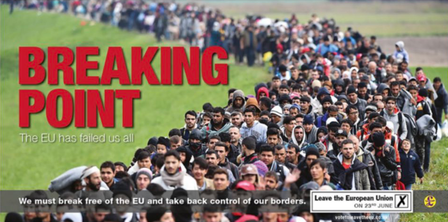
- During the Brexit campaign, Farage produced the controversial “Breaking Point” poster, widely compared to Nazi propaganda, further fueling xenophobic sentiments.
- In 2020, in response to Black Lives Matter protests in London, Farage said, “A new form of the Taliban was born in the UK today. Unless we get moral leadership quickly our cities won’t be worth living in.”
- Despite widespread backlash, Farage has refused to apologize for his statements, instead portraying himself as a defender of “British values” against political correctness. His rhetoric has reinforced far-right ideologies, contributing to the polarization of British politics and the normalization of extremist views.
- His comments about London being “unrecognizable as being English” were clearly xenophobic and racist. (see this video on Farage’s racism)
Farage and the 2024 Riots
After the tragic murder of three children in Southport on 29 July 2023, Nigel Farage posted a controversial video suggesting the public wasn’t being told the full truth about the suspect’s identity. His comments fuelled misinformation and Farage’s failure to retract or clarify his statement further stoked division. His questioning of whether the suspect was on a MI5 watchlist implied a potential connection to terrorism, which was a “dog whistle”to his followers, suggesting the attacker may have been a Muslim.
Farage’s Sexism and Misogyny
Nigel Farage has made a series of controversial and sexist remarks throughout his political career. These views collectively demonstrate Farage’s consistent tendency to perpetuate outdated, sexist attitudes, undermining women’s equality and limiting their opportunities in both the workplace and society.
- He defended Donald Trump’s “grab them by the pussy” comment, calling it “locker room banter” and downplaying its seriousness.
- He also suggested that breastfeeding mothers should “sit in the corner” to avoid being “openly ostentatious,” reflecting a dismissive attitude toward women’s natural roles as mothers.
- Farage further stated that women in banking who take maternity leave are “worth far less” to employers because they supposedly lose clients, demonstrating a lack of respect for working mothers and gender equality in the workplace.
- Under his leadership, UKIP proposed abolishing statutory maternity pay (SMP), replacing it with a low parental allowance that would have financially disadvantaged parents, especially women.
- Farage also expressed disbelief at the idea of women in combat roles or women’s football, claiming men and women are inherently different in such environments, which reinforced harmful gender stereotypes.
(Not) A Man of the People
Farage has capitalized on his political career and media presence, accumulating wealth and maintaining a lifestyle far removed from the working-class concerns he professes to represent. His populist rhetoric of anti-establishment and anti-elite sentiment is undermined by his personal wealth, career choices, and financial dealings.
- Farage comes from a wealthy background, having attended the elite Dulwich College and being the son of a stockbroker.
- Farage is a millionaire who has benefited from connections and privilege throughout his career. He worked as a metals trader, a position secured through a golf course meeting.
- He was one of the highest-earning Members of the European Parliament (MEP), earning between £524,000 and £700,000 from media work between 2014 and 2018.
- He has been controversially linked to an offshore trust fund in the Isle of Man and refuses to release his tax returns following the Panama Papers scandal.
- Farage’s claims of being “skint” in 2017 contradicted reports estimating his net worth at £2.4m. Additionally, he earned over £1.2 million a year on top of his MEP salary, including lucrative media contracts like a £81,607 payment from GB News for just 32 hours of work.
- Since becoming MP for Clacton in July 2024, Farage has made over £1.2 million in a year from at least twelve other jobs.
- Farage’s rank hypocrisy stems from his accumulation of wealth and connections to the corporate elite as he rails against the system for its corruption and greed. His financial dealings and lifestyle stand in stark contrast to the working-class image he projects.
Conspiracy Theories
Nigel Farage has long espoused conspiracy theories, aligning himself with far-right views and climate change skepticism. His stance is consistently anti-globalist and often dismissive of mainstream scientific consensus.
Farage has also expressed skepticism about global warming, suggesting that governments use it to push for global governance. He has referenced the Bilderberg Group and criticized efforts like the Copenhagen climate summit as part of a broader political class trying to undermine national sovereignty.
- Nigel Farage faces mounting scrutiny for promoting far-right and antisemitic conspiracy theories on US media between 2009 and 2018, including multiple InfoWars appearances with Alex Jones and shows with Rick Wiles, discussing “globalist” plots involving bankers, Goldman Sachs, and George Soros.
- In a 2018 interview with US conspiracy theorist Alex Jones, Nigel Farage claimed “mass immigration” was a left-wing plot to destroy nation-states, framing the EU as a prototype for a globalist “New World Order.” His rhetoric links immigration, globalism, and conspiratorial fears, reflecting far-right, nationalist, and anti-EU ideology.
- Farage has also expressed skepticism about global warming, suggesting that governments use it to push for global governance. He has referenced the Bilderberg Group and criticized efforts like the Copenhagen climate summit as part of a broader political class trying to undermine national sovereignty. His stance is consistently anti-globalist and often dismissive of mainstream scientific consensus.
Further Reading:
(https://hopenothate.org.uk/chapter/who-is-nigel-farage
https://www.bigissue.com/opinion/nigel-farage-ukraine-views/)

 STOP REFORM UK