The Cheeto’s lack of Transatlantic Appeal
Polling shows a majority of Brits have a negative view of Trump, which could be due to a variety of factors, from his rape convictions, close ties to the human trafficking paedophile Jeffrey Epstein, warmongering, willingness to do anything for money, rampant xenophobia, support for white supremacists or total lack of respect for human life beyond his domestic supporters.
- Three-fifths of those polled have a negative view of Trump due to his perceived chaotic leadership and conflicting/absent values.
- 45% were against Trump’s state visit
- Fifty-one per cent of Britons think that policies such as Trump’s trade tariffs will have a negative effect on the UK economy
- Polling shows the negative impact linking Farage to Trump: Farage’s close association with Donald Trump significantly harms his and Reform UK’s public image. Messaging that highlights this link caused an 8–10 point drop in Farage’s favourability and reduced belief that Reform addresses voters’ concerns.
- Even Reform voters are put off by the party’s association with the American government
Farage has been caught out lying when trying to defend Trump’s comments over who started the Ukraine war.
The Canadian right-wing party’s support for trump cost them a lot of support and the same could happen to Farage/Reform.
Farage’s support for Trump risks backfiring
Farage was forced to attack Trump during 2025 local elections due to Trump’s unpopularity in the UK
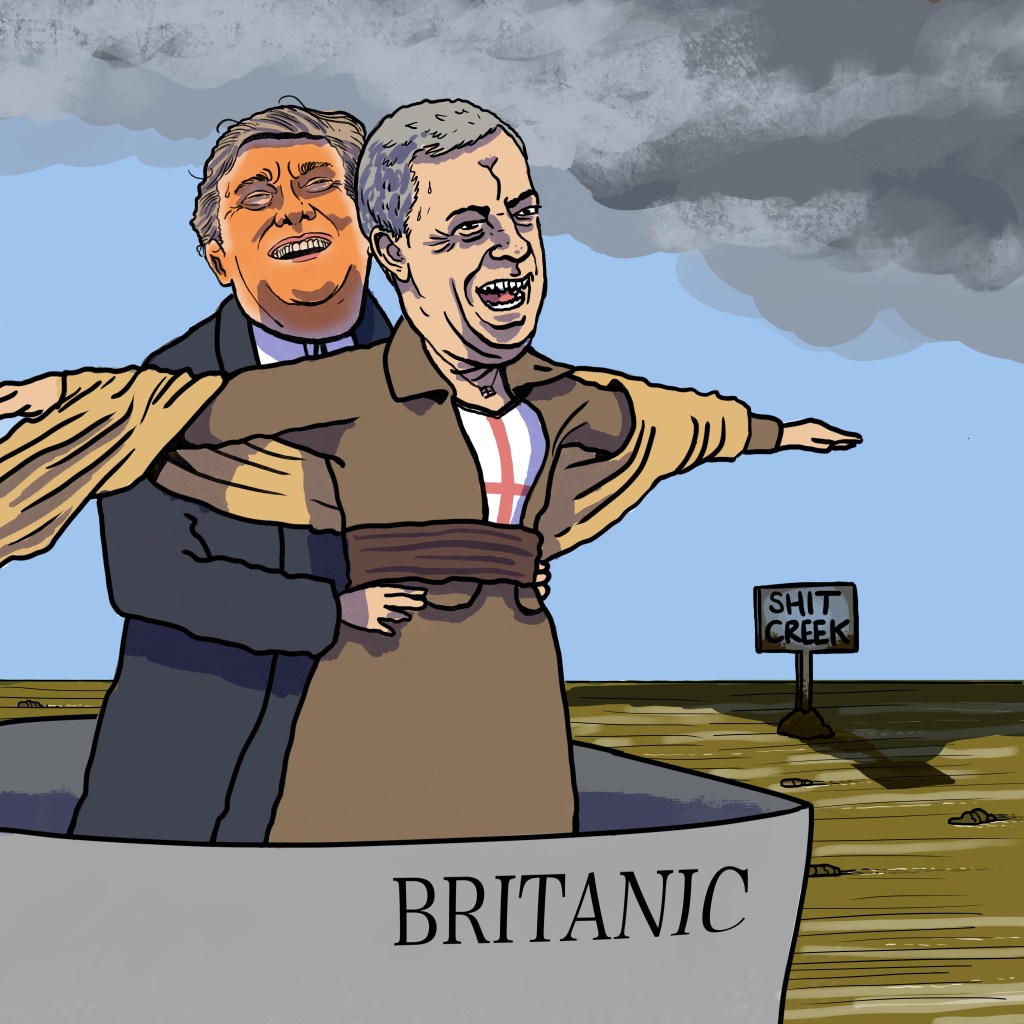
Links between Farage and Trump
Farage supported Donald Trump during the US elections in 2016, 2020 and 2024 elections. Trump team helped Reform in GE2024. In May 2024 a unanimous jury found Trump guilty on all 34 counts of falsifying business records to commit election fraud and Farage said he supported Trump more than ever. Even into Trump’s second term, Farage does not try to hide his support for Trump. Attending a fundraiser of Trump in March 2025. Even with Trump terrible’s. record in government and how Trump has made the poor suffer.
Reform UK government would echo Trump’s America
Farage has said Trump “serve as an inspiration” and that “Trump’s second administration is a model for Reform”. More about RUK’s crazed plans to emulate the Trump regime here.
Developments in the United States under Donald Trump’s second term illustrate the negative consequences of allowing powerful private interests to dominate politics. These include rising living costs, stagnant wages, aggressive immigration enforcement, and increased influence of wealthy individuals and corporations over government, contributing to growing regret among some Trump voters. The author warns that legal changes in the U.S. could further weaken restrictions on campaign finance, enabling billionaires to exert even greater political control.
The UK risks moving in a similar direction if it follows the political approach associated with Nigel Farage and Reform UK, alleging openness to opaque or crypto-based funding and policies mirroring those seen in the U.S. This would undermine democracy and empower oligarchic interests.
Reform UK is a British version of Trumpism
Reform UK, led by Nigel Farage, functions as the British counterpart to Trumpism. The party has deep political and financial ties to Donald Trump’s circle, with Farage frequently engaging with U.S. conservative networks and modelling his rallies and rhetoric on Trump’s. Reform UK promotes policies benefiting wealthy elites, uses anti-migrant scapegoating similar to Trump’s strategy, and contributes to a rise in racism and division.
That developments in the U.S. under Donald Trump, such as aggressive immigration enforcement, mass deportation efforts, militarised displays of power, abandonment of international commitments, and widespread disinformation, illustrate how democracy can erode. The UK is moving in a similar direction, claiming Nigel Farage has long adopted Trump-style tactics, including anti-immigrant rhetoric and appeals to grievance. Ideas once considered fringe have entered the political mainstream, reflecting a political system that fosters division and fails to curb extremism.
Trump is a threat to the NHS
Donald Trump is pushing measures that would drive up the cost of medicines for the NHS. Working alongside major pharmaceutical companies, he aims to pressure other countries into weakening their price controls, leaving us vulnerable to soaring, U.S.-level drug prices.
The long-standing concerns about US–UK trade deals harming the NHS are becoming more serious due to pressure from Donald Trump, who is reportedly threatening tariffs unless the UK weakens controls on drug pricing. Trump criticises countries like the UK for benefiting from lower medicine prices while Americans face much higher costs due to pharmaceutical companies’ ability to charge monopoly prices. The NHS caps prices and keeps costs manageable, and major pharmaceutical companies oppose this model. Some companies have withdrawn investment from the UK to pressure the government, prompting calls for investigation into possible coordinated behaviour. The UK government may be considering raising certain price caps and seeking US approval, which the government must resist this pressure, protect NHS funding, and promote a healthcare-driven model for future medicine development.
The UK government is considering demands from Donald Trump and major pharmaceutical companies to significantly increase the prices the NHS pays for medicines. Such a move could cost billions, boost pharma profits, and strain NHS budgets. Research suggests that diverting £1 billion per year to higher drug costs could lead to 4,500 avoidable patient deaths. Big pharma already earns substantial mark-ups from NHS sales, yet is pushing for even more. With powerful lobbying and Trump’s backing behind the proposal, campaigners argue that MPs must be pressured to resist these demands and protect the NHS from further financial stress.
 STOP REFORM UK